Khelo India Sports Goods Manufacturing Scheme 2026: What the Cabinet Approved and Why It Matters
When we watch a sporting event, we usually focus on the athlete, the score, and the medal.
But behind every performance is another part of the sporting world: the equipment. Someone designs the protective gear, manufactures the equipment, tests its quality and delivers it to the athlete.
That is where sports connects with manufacturing, research, skills and business.
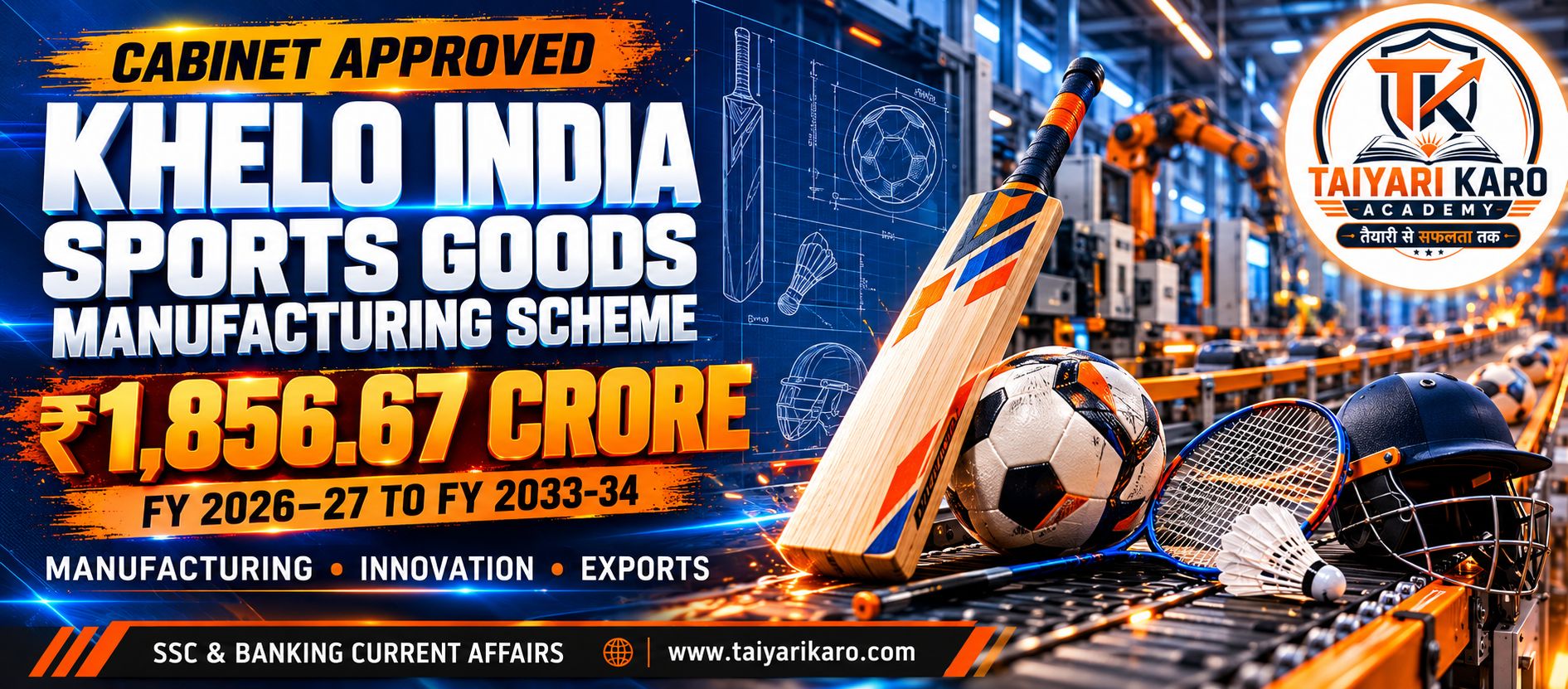
On 28 October 2026, the Union Cabinet approved the Khelo India Sports Goods Manufacturing Scheme, with an outlay of ?1,856.67 crore. The scheme covers FY 2026–27 to FY 2033–34 and aims to strengthen India’s sports goods industry.
For SSC and banking aspirants, this is a useful current affairs topic because it connects several areas: government policy, domestic manufacturing, employment, MSMEs and exports.
Let’s understand what was approved and what it could mean.
Table of Contents
-
What Is the Scheme?
-
Important Facts at a Glance
-
What Will the Scheme Support?
-
How Could Manufacturers and Athletes Benefit?
-
How Is It Different from the Khelo India Mission?
-
Important Economic Terms
-
SSC and Banking Revision Points
-
Frequently Asked Questions
1. What Is the Khelo India Sports Goods Manufacturing Scheme?
The scheme aims to strengthen the production of sports goods in India and improve the industry’s ability to compete internationally.
Its focus includes investment, technology, innovation, skills, quality certification and access to markets. It was announced in the Union Budget 2026–27 before receiving Cabinet approval in October.
Think of a manufacturer developing a new piece of sports equipment. Producing it is only one step. The business may also need better machinery, testing facilities, technical knowledge and buyers.
The scheme brings support for these different needs into a common framework.
2. Important Facts at a Glance
| Point | Detail |
|---|---|
| Scheme | Khelo India Sports Goods Manufacturing Scheme |
| Cabinet approval | 28 October 2026 |
| Cabinet chaired by | Prime Minister Narendra Modi |
| Total outlay | Rs. 1,856.67 crore |
| Period | FY 2026–27 to FY 2033–34 |
| Earlier announcement | Union Budget 2026–27 |
| Main focus | Sports goods manufacturing and competitiveness |
| Combined investment and turnover-linked support | Rs. 1,130 crore |
| International certification support | Rs. 105 crore |
The scheme’s financial provisions distinguish the total outlay from allocations for particular components.
Revision tip: Do not confuse ?1,856.67 crore, the total scheme outlay, with ?1,130 crore, which covers two specific support components.
Also, an approved outlay is a planned financial provision—not proof that the entire amount has already been spent.
3. What Will the Scheme Support?
Manufacturing zones that bring facilities together
The scheme proposes Sports Goods Manufacturing Zones, abbreviated as SGMZs.
These are intended to bring manufacturers, suppliers, testing facilities, design centres and related businesses together. The zones will draw on infrastructure under the BHAVYA Scheme and NICDC Industrial Parks.
Imagine a business having to travel to different locations for materials, product testing and design assistance. Bringing related facilities closer together could make coordination easier. That is the practical idea behind an integrated manufacturing zone.
Support for investment and higher production
Two components are:
-
Anchor Investment Support: Encouraging major manufacturers, brands and retail chains to establish manufacturing facilities.
-
Turnover Linked Support: Encouraging production growth and capacity expansion.
Their combined allocation is Rs. 1,130 crore.
An anchor manufacturer can also create opportunities for smaller suppliers nearby. For example, a large equipment producer may buy components, packaging or specialised services from other businesses.
Assistance for smaller manufacturers
The scheme includes upgrading existing manufacturing clusters and providing shared facilities for smaller enterprises.
PIB identifies Jalandhar in Punjab and Meerut in Uttar Pradesh as established sports goods manufacturing centres.
Shared facilities can matter because an individual small business may find specialised infrastructure expensive to develop on its own.
Quality certification, research and skills
The scheme provides ?105 crore to support manufacturers in obtaining and renewing certifications from International Sports Federations.
It also envisages research centres, start-up support and industry-linked skill development. Research collaboration includes the Anusandhan National Research Foundation, while skilling involves the Ministry of Skill Development and Entrepreneurship.
For a sports product, quality involves more than appearance. Performance, consistency and suitability for its intended use also matter.
4. How Could Manufacturers and Athletes Benefit?
The intended benefits extend across the industry:
| Group | Intended benefit |
|---|---|
| Manufacturers | Investment, technology and production support |
| MSMEs | Improved clusters and shared facilities |
| Start-ups | Support for developing and testing products |
| Workers | Industry-linked training opportunities |
| Exporters | Branding and market-development support |
| Sports sector | A stronger supply of quality equipment |
PIB describes these as expected benefits of the scheme.
Our assessment: The scheme addresses several connected business needs, but approval is only the beginning. Its eventual impact will depend on implementation, participation, product quality and demand.
For an exam answer, describe employment growth and higher exports as objectives or expected outcomes, rather than achievements already delivered.
5. Is This the Same as the Khelo India Mission?
The names are related, but their focus should not be mixed up.
| Initiative | Main emphasis |
|---|---|
| Khelo India Mission, announced in Budget 2026–27 | Talent development, coaches, sports science, competitions and infrastructure |
| Khelo India Sports Goods Manufacturing Scheme | Manufacturing, investment, equipment innovation, quality and markets |
The Budget announcement discussed the Khelo India Mission and a dedicated sports goods manufacturing initiative. The Cabinet decision concerns the manufacturing scheme.
A useful way to remember the distinction is:
The Mission addresses the wider sports-development system; the manufacturing scheme focuses on the industry producing sports goods.
6. Economic Terms You Should Understand
MSME
Micro, Small and Medium Enterprise.
In this context, it refers to smaller businesses involved in manufacturing or related activities.
Manufacturing cluster
A concentration of related businesses in a particular area. Firms may share access to workers, suppliers, knowledge and facilities.
Domestic value addition
The value created within India through activities such as processing, manufacturing and design.
Exports
Goods or services sold to buyers in other countries.
Turnover-linked support
Support connected to business turnover under the applicable rules. The exact eligibility and calculation should be checked in the scheme’s operational guidelines.
Learning these terms helps you explain the policy rather than simply remembering its name.
7. What Should SSC and Banking Aspirants Revise?
For SSC, focus on the scheme name, approval date, outlay, duration, objectives and manufacturing centres.
For banking examinations or stages with General/Financial Awareness, also understand the connections with MSMEs, investment, production and exports.
These are revision priorities, not predictions of exact questions.
| Quick question | Answer |
|---|---|
| When did the Cabinet approve the scheme? | 28 October 2026 |
| What is its total outlay? | Rs. 1,856.67 crore |
| What period does it cover? | FY 2026–27 to FY 2033–34 |
| In which Budget was it announced? | Union Budget 2026–27 |
| What does SGMZ stand for? | Sports Goods Manufacturing Zone |
| Combined investment and turnover-linked support? | Rs. 1,130 crore |
| Certification support allocation? | Rs. 105 crore |
| Two established manufacturing centres? | Jalandhar and Meerut |
The figures and locations above are drawn from the Cabinet release and PIB explanatory note.
8. Frequently Asked Questions
Is this a scheme for distributing cash directly to students or athletes?
The Cabinet announcement focuses on sports goods manufacturing and its supporting industry. It does not describe a general direct-cash benefit for students or athletes.
Will every manufacturer automatically receive support?
Approval does not establish automatic eligibility for every business. Applicants will need to follow the relevant guidelines, conditions and application process.
Does the scheme guarantee new jobs?
Employment generation is an intended outcome. Actual results will depend on implementation and business activity.
Why does international certification matter?
Recognised certification can help manufacturers demonstrate compliance with relevant sporting standards and improve access to markets.
Why is this useful for exam preparation?
It connects a recent Cabinet decision with manufacturing policy, MSMEs, skills and international trade—several topics that can be studied together.
Prepare Current Affairs with Taiyari Karo Academy
After reading a government scheme, try answering five questions:
What is its name? Why was it introduced? How much is the outlay? What period does it cover? What will it support?
If you can explain those points in your own words, you have understood more than the headline.
Explore the SSC CGL Foundation Batch 2027 and SBI PO Foundation Batch 2027 at Taiyari Karo Academy for guided preparation, interactive classes, doubt support and regular tests.
Taiyari Karo Academy
Nirman Vihar, Laxmi Nagar, Delhi
Website: www.taiyarikaro.com
तैयारी से सफलता तक